



Global Ethical Hacking Specialist (GEHS)
Lead offensive security strategies and identify critical vulnerabilities before they are exploited.
- Senior Penetration Tester
- Red Team Operator
- Security Consultant
- Cloud Security Specialist
- Cyber Risk Analyst

Professional-level certification programs in cybersecurity and digital governance, delivered globally by industry leaders and academic experts.
In academic collaboration with
NITTTR Chandigarh
300+ LabsReal-world scenariosLead offensive security strategies and identify critical vulnerabilities before they are exploited.
Blend privacy leadership with SOC operations—real-time detection, triage, and investigation at scale.
Uncover digital footprints and lead complex cyber investigations for law enforcement.
Protect the backbone of society by securing power grids, water systems, and plants.
Our certifications are mapped to globally accepted cybersecurity standards and frameworks, and are offered in academic collaboration with NITTTR Chandigarh.
Certification Programs
From critical security skills to specialized domains, our programs support your professional development at every stage.
GEHSOffensive Security
Master the art of ethical hacking. Think like an attacker, break systems legally, and build defensive intelligence that protects modern enterprises.
GDSIDefensive Security
Blend data-protection officer competencies with SOC investigations. Master real-time threat detection, SIEM workflows, and privacy-aware operations at scale.
GDFIDigital Forensics
Investigate, recover, and analyze digital evidence. Become the first responder organizations call when breaches happen.
GICICIICS / OT Security
Protect power grids, water systems, and manufacturing networks from sophisticated nation-state adversaries.
Offensive Security
Master the art of ethical hacking. Think like an attacker, break systems legally, and build defensive intelligence that protects modern enterprises.
Defensive Security
Blend data-protection officer competencies with SOC investigations. Master real-time threat detection, SIEM workflows, and privacy-aware operations at scale.
Digital Forensics
Investigate, recover, and analyze digital evidence. Become the first responder organizations call when breaches happen.
ICS / OT Security
Protect power grids, water systems, and manufacturing networks from sophisticated nation-state adversaries.
Every programme includes
Four pathways, one standard
Same structure and rigor across every track — different skills, audiences, and career outcomes. Tap a programme to spotlight it, then scan the row that fits your next role.
| Course | Best For | Core Skill | Career Roles | Exam Output |
|---|---|---|---|---|
Certified Global Ethical Hacking Specialist (GEHS)Explore program |
|
| Executive-level security report16-hour exam · 6h live red-team lab | |
Certified Global DPO & SOC Investigator (GDSI)Explore program |
|
| SOC investigation report16-hour exam · 6h live SOC simulation | |
Certified Global Digital Forensics Investigator (GDFI)Explore program |
|
| Court-ready forensic report16-hour exam · 6h forensics lab | |
Certified Global Industrial & Critical Infrastructure Cybersecurity Investigator (GICICI)Explore program |
|
| Executive OT risk report16-hour exam · 6h live ICS lab |
Every programme includes
Identical structure — differentiated by domain
GTPC certifications follow the frameworks, regulations and control catalogues that define professional practice —
across defence, application security, OT, forensics, compliance and privacy.
HIPAAUS healthcare information privacy
TSCTrust services criteria
India DPDP ActDigital personal data protection
NIS2 DirectiveEU network & information security
NERC CIPCritical infrastructure protectionFramework and standard names and marks are used descriptively to describe curriculum coverage. They do not imply endorsement, affiliation or accreditation by the issuing bodies.
Every GTPC certification runs to the same standard: six weeks of live instruction from practising CISOs, CTOs and industry specialists, then two full weeks in the labs — so you finish able to do the work, not just describe it.
2 Weekday Classes (7:00 p.m–9:00 p.m) + 1 Weekend Class (10:00 a.m–2:00 p.m)
Weeks 1–648 hours
Instructor-led live training
Eight hours a week, live with the faculty — no recordings standing in for a session.
Weeks 7–832 hours
Labs, projects & certification exam
Two full weeks of hands-on lab work, practical exercises, assessments and the certification examination.
Shared learning outcomes across every GTPC certification track.
Design, defend and recover systems that withstand real-world attacks and keep the business running.
Translate global regulation and IT policy into controls that stand up to audit and scrutiny.
Work across engineering, legal and leadership teams to ship secure solutions, not silos.
Communicate risk to the board and lead security programmes with strategic, ethical judgement.
Apply AI-assisted tooling to detect, investigate and neutralise threats at modern speed and scale.
Taught by
Designed for
Every programme runs 16 modules, grouped into 5 parts and taught over 8 Weeks. Pick a certification below, then open any module to read the chapters inside it.
Choose a certification
4 programmes · 8 Weeks · 80 Hours eachWork through the parts
Then open any module to read its chaptersModules 01–03 of 16 · 10 chapters
Core concepts, terminology, and entry-level security skills.
Beginners & IT professionals new to security
Hands-on tools, techniques, and domain-specific operations.
Security analysts & network administrators
Specialized tracks: offensive security, forensics, SOC, ICS.
Experienced practitioners targeting senior roles
Leadership, architecture, and strategic security advisory.
CISOs, architects & policy advisors
A growing community of certified professionals connected across continents — building careers in security, forensics, and critical infrastructure.
Every certification track is delivered live by practitioners who run security, AI and risk inside the companies our learners want to work for — not by career trainers. They teach the same playbooks they use at work, with curriculum oversight from academic advisors at NITTTR Chandigarh.
Nangia NXT
DSK Legal
Quess Corp
BECILAI & Technology Leader
11+ years in AI/ML security and adversarial machine learning
Deputy General Manager
17+ years in financial forensics and ERP fraud investigation
Head of Department — Cybersecurity
22+ years in cybersecurity governance and executive advisory
Director — IT Delivery
16+ years in offensive security and adversarial simulation
Cybersecurity Leader
20+ years in industrial control systems and OT security
Strategic Partner Account Manager
13+ years in cloud security and XDR architecture
Head & Additional GM — IT, Digital Transformation
IT and digital transformation leadership at BHEL — critical infrastructure & power
Data Security Strategist & AI Security Specialist
20+ years across cybersecurity, enterprise IT and cloud transformation
Associate Director
Digital engineering and enterprise IT delivery at Nagarro
Technology Advisory & Risk Consulting
16+ years in consulting across private and government sectors
Professor & Ex-Senior Scientist — ISRO
35+ years at ISRO / Department of Space, Govt. of India (1983–2018)

Senior Advisor — Cybersecurity
Two decades advising and training across cybercrime investigation, digital forensics awareness and public cyber literacy
Former Superintendent of Police, Cyber Crime
24+ years in digital forensics and cyber law

Partner
19+ years in cyber law and data breach litigation

General Counsel & SVP Legal — Global DPO
20+ years leading legal, privacy and compliance across APAC, the Americas and Europe

National Security Strategist
20+ years in national security and strategic affairs
Company names and marks identify where each instructor works or has served and are used descriptively. They do not imply endorsement, sponsorship or affiliation by those organisations, who are not partners of GTPC.
Hear from professionals who transformed their careers with our certification programs.
“The course was manageable alongside my full-time job. The sessions were structured well, and most importantly, I could relate the topics to situations I deal with at work.”
“For me, the labs were the strongest part of the program. Reading about an attack is one thing, but working through the scenario yourself gives you a completely different understanding.”
“I had been following AI governance discussions for some time, but mostly at a high level. The program helped me understand the connection between policy, risk, accountability and implementation.”
“The forensics sessions helped me understand the investigation process in a structured way. Earlier I knew individual tools, but I wasn’t very clear about how an actual investigation should progress.”
“The SOC-related modules were close to what happens in an actual security operations environment. The examples around alerts, investigation and response were particularly useful for me.”
“Governance stays very abstract if you only read about it. Working through actual scenarios helped me see where accountability sits and what documentation is genuinely expected.”
“The discussions around actual incidents were more useful to me than textbook examples. They made it easier to understand why certain controls work in theory but become difficult in real environments.”
“I am not involved in every technical activity myself, but the program helped me ask better questions when discussing security with our technical teams.”
“There was enough room to ask questions instead of rushing through the syllabus. A few of the discussions that started from student questions ended up being the most valuable parts of the course.”
“My background is more in compliance than technical security. The program helped me understand what actually sits behind many of the controls we discuss during audits.”
“I wouldn’t say one course makes anyone an expert, but I definitely finished this program with more confidence in approaching security problems independently.”
“Before this program I tended to look at security events individually. The investigation exercises taught me to step back, build a timeline and look at the complete picture.”
“Coming from an academic background, I wanted to understand what cybersecurity looks like outside the classroom. Hearing directly from industry professionals made that transition easier to understand.”
“The interaction with other participants was surprisingly useful. People came from different roles, so the same problem was often discussed from technical, management and compliance perspectives.”
“What stood out for me was being able to discuss doubts with people who have actually worked in the field. Sometimes a ten-minute discussion clarified something I had been reading about for weeks.”
“I had studied cybersecurity before, but this was the first time I felt I was actually connecting the concepts with real situations. The practical sessions made a big difference.”
“The instructors didn’t just go through slides. They shared examples from projects and incidents they had actually worked on, which made the discussions much more useful.”
“I joined with basic cybersecurity knowledge and quite a few gaps. By the end of the program, I had a much clearer understanding of how different security functions work together.”
“I initially joined because I wanted a professional certification. What I valued more was the way the program helped me organize what I already knew and identify what I still needed to learn.”
“Some of these topics can become very technical very quickly. The trainers explained them without unnecessarily complicating things, which made the sessions easier to follow.”
“Even after working in IT for several years, there were areas where my knowledge was based more on experience than structure. This program helped put that experience into a proper framework.”
“I was trying to move from general IT into cybersecurity and wasn’t sure what to focus on first. The program gave me a much clearer learning path.”
“The ethical hacking modules helped me understand the thinking behind an attack instead of simply memorizing tools and commands. That change in perspective was useful.”
“I liked that the curriculum had a clear flow. Each module built on the previous one, so I didn’t feel like we were jumping randomly between cybersecurity topics.”
“OT and critical infrastructure security was something I wanted to understand beyond general IT security. The course gave me a much better appreciation of why the two environments have to be approached differently.”
“A lot of professional courses repeat information you can easily find online. Here, the useful part was the context provided by the trainers and the discussions around implementation.”
“There was a good balance between concepts and practical work. We were given enough theory to understand why something matters and then an opportunity to see how it works.”
“The program gave me a more practical way to think about governance. Instead of looking at policies only as documents, we discussed how they affect technology, people and actual business decisions.”
“There were several things from the sessions that I could relate back to my current work almost immediately. That made the learning feel relevant rather than purely academic.”
“The program was professional without feeling overly formal. The curriculum was relevant, the faculty was approachable, and the practical discussions kept the sessions interesting.”
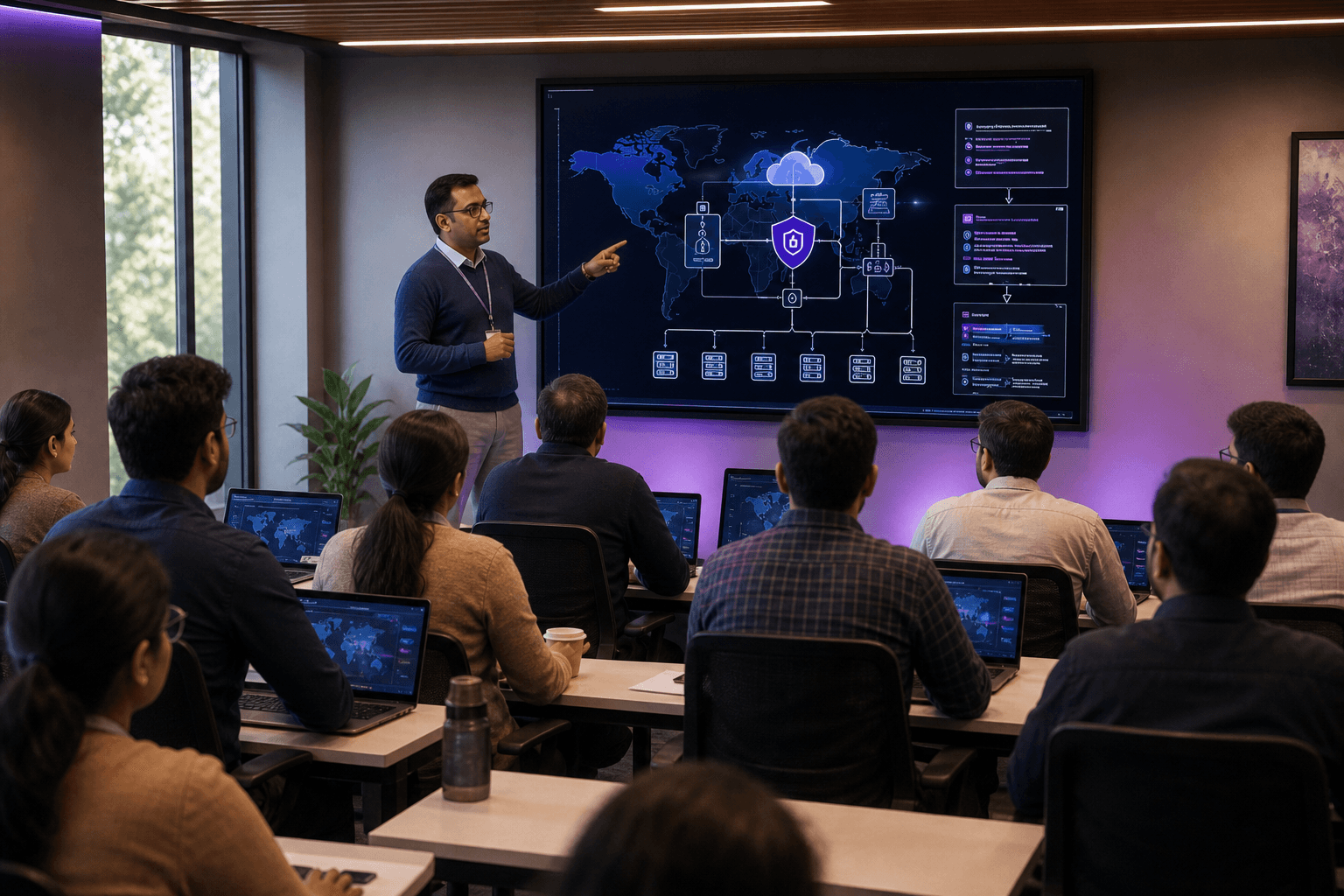
The GEHS program prepares cybersecurity professionals with the knowledge and skills to perform effective ethical hacking. It immerses students in intensive labs, enabling them to work on real-world penetration testing scenarios. Students learn how to acquire and manage vulnerabilities through various operating environments, ensuring security readiness for their organizations.
Every GTPC certification runs over 8 weeks. Weeks 1–6 deliver 8 hours/week of instructor-led live training (48 hours in total), with weekday and weekend learning options and live online interactive classes. Weeks 7–8 are dedicated to hands-on labs, practical exercises, projects, assessments and the certification examinations (32 hours in total).
The program provides 80 learning hours in total: 48 hours of instructor-led live training across weeks 1–6, plus 32 hours of hands-on labs, projects, assessments and certification examinations across weeks 7–8.
Yes. Live classes are delivered online with weekday and weekend learning options, so working professionals and students can keep a manageable weekly load across the 8-week program.
Build practitioner-level skills mapped to globally accepted cybersecurity frameworks, designed for enterprise and government use cases. Join a growing global community of certified professionals.
Fill out the form and our team contacts you within 24h